A Reader’s Map for Untangling a Public Debate
A reader’s map for untangling a public debate helps separate the disputed question, competing claims, shared terms, and unresolved points without losing nuance.
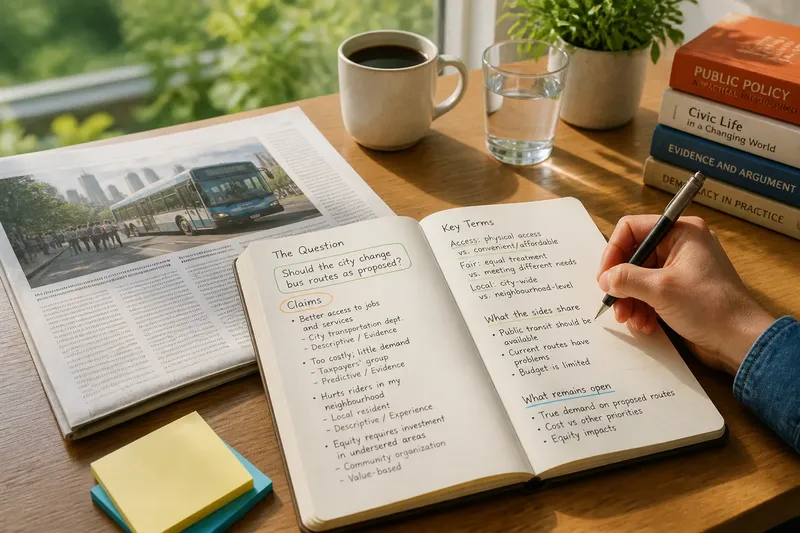
The most common mistake in a public debate is treating a loud disagreement as one clear question. That can leave you arguing past the people involved, or repeating a claim whose meaning shifts from one speaker to the next. A reader’s map for untangling a public debate gives you a simple way to see what is actually disputed—and what remains open.
The aim is not to pick a side as quickly as possible. It is to read carefully enough to know which question a statement answers, what each side is claiming, and where the disagreement still depends on evidence, values, or future events. Keep a blank page beside the article, report, or public statement you are reading. Write short notes in your own words rather than copying its most forceful phrases.
What is being disputed?
Start by turning the debate into one question that a person could reasonably answer in more than one way. A topic such as a proposed school phone policy is too broad. A more useful question might be: “Should students be required to keep phones put away during class?” That phrasing names a decision, a setting, and the point on which people may disagree.
Try to make the question narrow without making it unfair. If the issue concerns whether a city should change bus routes, do not reduce it to “Do people support public transit?” That asks about a broad principle, not the route change under discussion. Nor should the question smuggle in a conclusion: “Should the city finally fix its broken bus system?” assumes both failure and a particular remedy.
As you read, separate three things that can get bundled together:
- The decision: What action, rule, or policy is under discussion?
- The reason: What problem do supporters or opponents say the decision addresses?
- The standard: What would count as a good or bad result to the people involved?
Those distinctions help when a source begins with one question and slides into another. A speaker may oppose a specific proposal while supporting its stated goal, or support the goal while doubting that this proposal will achieve it. Your map should preserve that difference.
How do I define the question?
Write the question as a single sentence, then check whether it leaves room for different answers. Look for hidden assumptions about who acts, who is affected, what time period matters, and which alternatives are being compared. If a detail changes the answer, include it; if it merely adds background, leave it out for now.
Imagine you are reading about a library considering later opening hours. “Should the library stay open later?” leaves important details vague. Say you rewrite it as, “Should the library extend evening hours on weekdays if doing so requires shifting staff time from other services?” The revised question makes the tradeoff visible. Your next reading task is now clearer: find out what benefits are expected, which services might change, and what information is available about staffing.
Keep the original question nearby if the debate is moving. Public arguments often widen from one proposal into judgments about fairness, public spending, or trust. Those larger concerns may matter, but they are not automatically the same dispute. Note them as related questions rather than letting them silently replace the one you started with.
What does each side claim?
List claims in plain language, giving each one its own line. Avoid labels such as “the sensible side” or “the alarmists”; those describe a reaction, not an argument. If a position has several strands, break them apart. A person might say a policy would help some residents, impose a burden on others, and fail to address the underlying cause. Those are separate claims and may call for different kinds of support.
For each claim, note who is making it and what kind of statement it is. A claim might report an observable condition, predict a likely outcome, interpret a rule, or express a value. These types should not be judged by the same standard. A prediction needs reasoning about what may happen; a value judgment needs its underlying priority made clear.
- Claim: What is being asserted, in a sentence?
- Speaker: Is it a public official, affected person, organization, specialist, or commentator?
- Support offered: Is there a document, explanation, example, or only an assertion?
- Type: Is the statement descriptive, predictive, interpretive, or value-based?
This is not a credibility score. It is a way to see what a source has actually put forward. A person’s experience can illuminate a consequence while leaving a broader prediction unanswered. A formal document can clarify the wording of a proposal without settling whether the proposal is wise. Keep those contributions distinct.
Which words carry different meanings?
Circle words that seem to do more than one job. In public arguments, terms such as “fair,” “safe,” “local,” “effective,” and “access” can sound shared while pointing to different standards. One speaker may use “fair” to mean that everyone follows the same rule; another may mean that people with different needs receive different support. Both may sincerely claim to favor fairness, yet disagree about what it requires.
For each recurring term, write down how the speaker appears to use it. Then ask whether the difference is about definition, evidence, or priority. If two people define “access” differently, they may need to clarify what the word covers. If they agree on the definition but disagree about who currently has access, they need to examine the relevant facts. If they agree on both and still favor different choices, they may value competing outcomes differently.
Do not rush to declare a word meaningless just because people use it differently. The difference may reveal the heart of the debate. Nor is it necessary to settle every definition before reading further. Mark the term, write the competing meanings, and return to the argument with that distinction in view.
What do the sides share?
Look for premises or aims that people on opposing sides appear to accept. They may agree that a service should be available, that a rule should be understandable, or that a problem deserves attention while disagreeing about the best response. Shared ground can show whether the dispute concerns the goal, the means, the likely consequences, or who should bear a cost.
Write shared points as cautiously as the claims. If one speaker says, “Everyone deserves a chance to participate,” and another says, “The current rules keep some people from participating,” those statements may share a concern about participation. They do not prove agreement on the cause or remedy. A careful map records the overlap without pretending it resolves the dispute.
Next, look for a point where the arguments branch. Perhaps one side expects a proposed change to improve participation, while another expects it to create a different barrier. That branch is more informative than a list of slogans: it tells you what the sides think will happen and what each would treat as evidence of success.
What remains unresolved?
Mark unresolved points explicitly rather than treating silence as an answer. The open question might be factual: a relevant document has not been provided. It might concern prediction: people agree about current conditions but expect different consequences. Or it might be a value conflict: the sides accept the same likely tradeoff but rank its costs differently.
Separate what could be clarified by more information from what requires a judgment. A missing definition, an unclear proposal, or an unreported condition may be clarified by checking a primary document or asking a direct question. A disagreement over which burden matters more may remain even after both sides accept the same facts. Naming that difference prevents endless searching for one piece of information that cannot settle a value choice.
Use a short “still open” list at the bottom of your page. Keep each item specific enough to guide the next reading:
- What wording or detail in the proposal is unclear?
- Which claim lacks support in the material you have read?
- What outcome do the sides predict differently?
- Which value or tradeoff does each side prioritize?
- What would change your understanding of the question?
How should I read further?
Let the unresolved list guide your next source. If the wording of a proposal is unclear, seek the proposal itself rather than another summary of it. If a claim relies on a stated rule, look for the relevant policy or public document. If the disagreement concerns how an affected group experiences a change, seek accounts from people with that perspective and keep their scope clear.
Read with a specific question in mind, not just a desire to collect more material. A second source may repeat the first source’s claim in different language. That can help you understand the argument, but it does not independently settle the point. Note whether a source supplies new evidence, a new perspective, a clearer definition, or only a sharper opinion.
It is not worth the effort to make the map look like a perfect courtroom record, or to assign every sentence a formal category. A few accurate lines are more useful than an elaborate chart you stop updating. Keep the wording neutral, distinguish what is asserted from what is established, and leave room to revise your notes.
How can I tell when the map is useful?
Your map is useful when you can explain the disagreement without caricaturing either side. You should be able to state the disputed question, summarize the main claims, identify the meanings people attach to important terms, and name what has not been settled. You do not need to agree with every claim or reach a final verdict.
Try explaining the debate aloud in a few sentences. If you keep switching between a policy’s goal and its details, the question may still be too broad. If you cannot tell whether a disagreement is about facts or priorities, revisit the claims and shared terms. If one side seems to have disappeared from your notes, check whether the sources you read actually represented its argument.
A reader’s map for untangling a public debate is not a verdict machine. It is a way to keep the question steady while the arguments shift around it. The most useful next move may be a source, a clarification, or simply a more honest note: “These points are still unresolved.”