The Carbon-Neutral Claim: What It Does and Does Not Mean
A carbon-neutral claim can hide important choices about emissions and offsets. Learn what to check so you can judge its climate meaning more clearly.
The most common mistake with a carbon-neutral claim is treating the phrase as a complete account of a product’s climate impact. It can cost readers the chance to notice which emissions were counted, which were left out, and what offsets are doing in the calculation. The phrase has meaning, but only alongside the boundaries and methods behind it.
When you encounter a carbon-neutral claim on a package, company website, or event announcement, start by asking what activity it covers. A claim about one product is not automatically a claim about the company that made it. A claim about a company’s operations may not include the emissions tied to suppliers, customer use, or disposal. Those distinctions are not fine print; they define the claim.
Scope confusion
What goes wrong: A claim sounds broad, while its actual boundary is narrow. “Carbon-neutral product,” for example, might refer to selected stages of production rather than the full path from raw materials to disposal.
Why it happens: Emissions can arise in many places: extracting materials, making components, moving goods, powering a facility, using a product, and handling it at the end of its life. Organizations must choose which activities to include in a particular accounting exercise. Some emissions are directly controlled; others occur in supply chains or through customer behavior and are harder to estimate.
What to try: Find the explanation of the claim’s boundary. Look for terms such as “operations,” “product life cycle,” “supply chain,” or “selected activities.” Then ask whether the statement covers the particular thing you care about. If a delivery service says its operation is neutral, that does not by itself tell you about the manufacture or later disposal of the goods it carries.
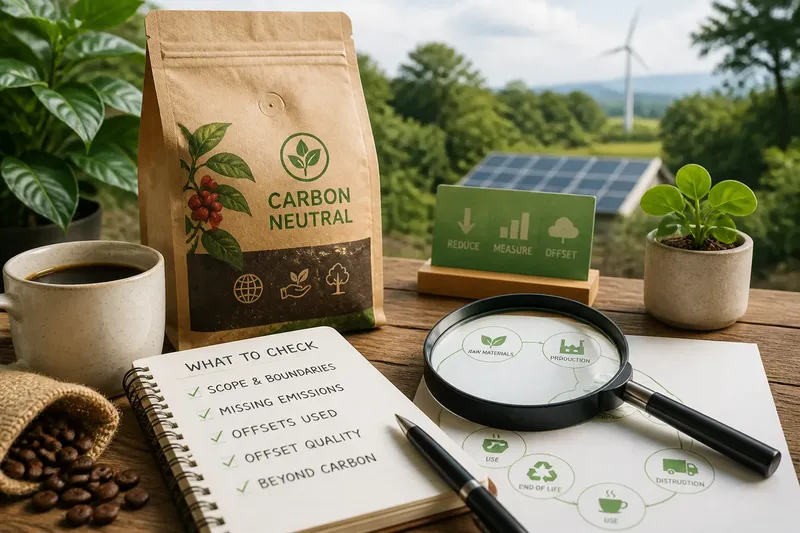
Say you see a carbon-neutral claim on a coffee bag. Imagine the accompanying explanation says it counts roasting and packaging but excludes farming and brewing. That is a narrower claim than one covering the coffee’s whole life cycle. You can still consider the stated effort meaningful, but you should not read it as a description of every emission associated with the coffee.
Missing emissions
What goes wrong: A calculation leaves out emissions that matter to the activity, or treats uncertain figures as if they were settled.
Why it happens: Organizations may lack complete information from suppliers, especially when materials pass through several stages or regions. They may use estimates, standard factors, or older records to fill gaps. Estimates are often necessary, but their assumptions affect the result. A tidy total can conceal uneven data quality.
What to try: Look for a description of the emissions sources included and how missing information was handled. A useful account distinguishes direct measurements or supplier data from estimates where it can. Also check whether the claim has a stated period. A calculation for one reporting period does not automatically describe the next, particularly if production, energy sources, or suppliers change.
Be alert to changes in scope. If a business reports a lower footprint after removing an activity from its accounting boundary, that is not the same as reducing the activity’s emissions. The explanation should make clear whether the underlying operation changed or the calculation changed.
Offset confusion
What goes wrong: Readers assume that “neutral” means emissions were eliminated at their source.
Why it happens: Some claims subtract credits associated with activities outside the organization’s own operations. Such credits may represent projects intended to avoid emissions or remove carbon from the atmosphere. They are not the same thing as reducing emissions from a factory, vehicle fleet, or supply chain.
What to try: Find out whether offsets are used and, if so, what kind. Ask what project or activity the credits represent, what standard or accounting approach is named, and whether the claim explains how credits are matched to the emissions being counted. A reader need not become an offset auditor to notice whether the explanation is specific or merely says that credits were purchased.
There is a practical distinction between reducing emissions and compensating for them. A company might cut fuel use in its own delivery network and also buy credits for remaining emissions. Those are separate actions. A clear account identifies both rather than letting the offset portion stand in for the reduction.
Offset quality questions?
What does “additional” mean?
It asks whether the credited activity would likely have happened without the credit revenue or incentive. If a project would have proceeded anyway, the credit may not represent an extra climate benefit attributable to its financing.
How long does a removal last?
Some approaches store carbon in places or materials that can later release it, while others aim for more durable storage. Look for an explanation of reversal risks and how they are addressed rather than assuming every removal has the same permanence.
Could the same benefit be counted twice?
Credible accounting needs a clear way to prevent multiple parties from claiming the same climate benefit as their own. Check whether the claim explains who owns or retires the credits and how the accounting avoids duplicate claims.
Does a project affect people or nature?
A carbon credit describes an accounting relationship, not a complete assessment of a project’s local consequences. Where the project affects land, water, livelihoods, or habitats, look for separate information about those impacts and how affected communities are involved.
Carbon-neutral scope
What goes wrong: The phrase is mistaken for a claim about every environmental effect, including those unrelated to greenhouse gases.
Why it happens: “Carbon” is often used conversationally to refer to climate pollution, but a carbon-neutral calculation generally concerns a defined set of greenhouse gas emissions expressed in a common accounting form. It does not automatically cover water use, toxic pollution, habitat loss, mining impacts, or waste. Nor does it tell you whether a product is durable, repairable, or responsibly sourced.
What to try: Separate the climate claim from broader environmental questions. If you are considering a product, ask what its materials are, how it is made, whether it can be repaired, and how it is disposed of. If you are judging an organization, look for separate reporting on relevant impacts rather than treating one climate label as a general seal of approval.
This distinction matters in public discussion, too. A carbon-neutral label can be relevant evidence about an organization’s stated approach to emissions, but it cannot settle a wider debate about land use, pollution, or the fairness of a transition. The claim answers a bounded question; other evidence is needed for the rest.
Vague wording
What goes wrong: The statement uses confident language without making the underlying accounting easy to find.
Why it happens: A short label has little room for explanation, and organizations may put technical details in a separate report. But broad words such as “clean,” “green,” or “climate friendly” can also leave readers unsure whether the statement refers to emissions, offsets, or a different environmental attribute.
What to try: Search the organization’s site for a methodology, emissions inventory, sustainability report, or explanation of the claim. Check whether it names the boundary, period, emissions sources, and use of offsets. If those details are absent, treat the label as an unsupported or incomplete statement—not as proof of misconduct, but not as a full account either.
It is not worth the effort to chase every technical term in a long report before making an ordinary reading judgment. Start with the boundary and whether offsets are involved. Those two questions often show what the claim does and does not cover; dig further when the decision has greater consequences.
Reading the claim
A carbon-neutral claim is best read as a statement about a defined emissions calculation, not as a synonym for “no climate impact.” To assess one, work through these checks in order:
- Identify the subject: Is the claim about a product, service, event, facility, or whole organization?
- Find the boundary: Which stages, operations, or supply-chain activities are included?
- Check the period: Does the statement identify the time covered by the calculation?
- Look for omissions: Does it explain estimates, excluded sources, or changes in accounting?
- Separate reductions from offsets: Does the organization describe each distinctly?
- Inspect the credit explanation: Are project type, credit treatment, and relevant risks described?
- Keep other impacts separate: What environmental or social questions does the claim leave unanswered?
When the explanation is clear, you can judge the stated effort on its own terms. When it is vague, the careful response is to withhold conclusions about the organization’s overall climate impact and ask for the missing details. A label is a starting point for scrutiny, not a substitute for it.
The most useful habit is to carry the boundary with you whenever you repeat the claim: neutral with respect to which emissions, for what activity, and through what accounting? That small qualification keeps a narrow statement from expanding into a promise it never made.